
Andrea Lilian Rodríguez: Economies of the Unproductive in Matter
Research and writing: Area Temporal Editorial TeamArchive: Artistic Mapping Open Call 2026
Andrea Lilian Rodríguez situates her practice at a point of friction between craft, memory, and the expansion of the contemporary sculptural field. Developed since 2009, her work proposes a critical revision of inherited carpentry as both a technical and affective language, displacing it toward what she defines as an “un-useful carpentry”: a system of production in which functionality is suspended so that matter itself may become a form of thought.
Within this displacement, wood ceases to function as a utilitarian support and instead becomes a territory for formal and perceptual experimentation. The artist articulates processes of molding, assembly, and carving that activate tensions between volume, geometry, light, and shadow. These operations do not seek to stabilize form, but rather to introduce it into a state of visual instability where the object oscillates between sculptural presence and optical illusion. In this transition, sculpture approaches the image, while the image acquires material density.

One of the conceptual cores of her work lies in the understanding of light as an active material. Far from operating solely as an exhibition resource, light intervenes as an agent that reorganizes the structure of the pieces, expanding their pictorial dimension. This non-illustrative use of luminosity shifts the work toward an intermediate field where visibility is not exhausted by form, but instead opens onto the suggested, the intermittent, and the incomplete.
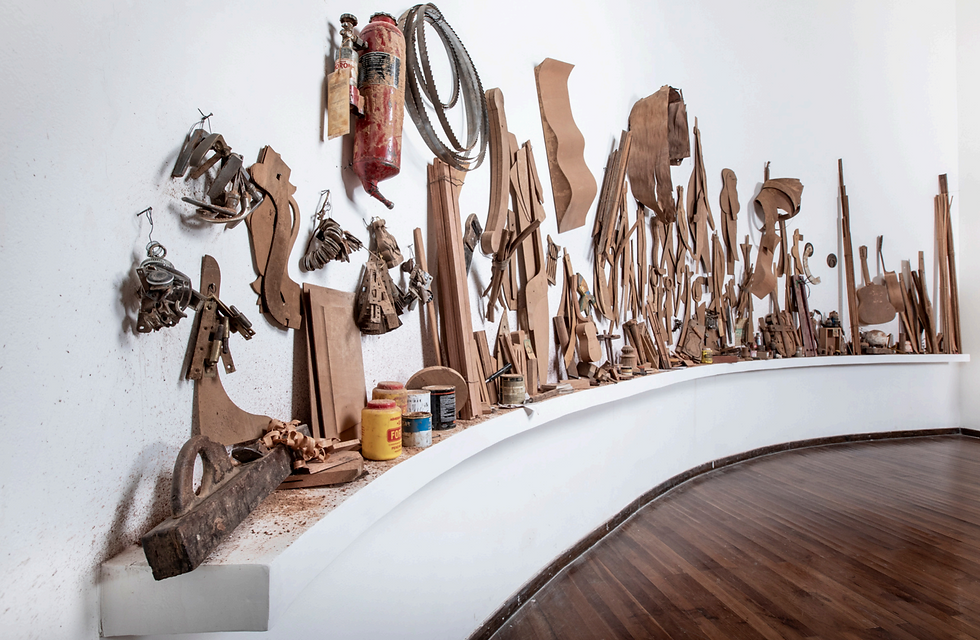
Rodríguez’s production is also nourished by an inherited domestic archive: molds, templates, modules, and fragments originating from her family’s carpentry environment. Yet these elements do not function as nostalgic remnants or closed documents of the past. On the contrary, they are activated as dispositifs of rereading, capable of reconfiguring memories in tension with the present. In this sense, the archive does not preserve: it produces friction.
This archival dimension introduces a broader reading of her practice, where the intimate intertwines with the collective. The inheritance of craft does not emerge as linear continuity, but as a field of dispute in which transmitted forms of knowledge are dismantled and reorganized. Her work thus constructs an interrupted genealogy, where artisanal tradition is rewritten through contemporary logics of abstraction, spatiality, and expanded perception.

Within this framework, each work may be understood as an open system. These are not closed objects, but structures dependent on the activation of space and the viewer’s experience in order to complete their internal relations. The gaze does not merely observe: it reorganizes.
Her trajectory includes solo exhibitions such as Imminence of the Mold (Galería Mamoré, 2023) and recent projects including Open Studio (Residencia Ambulante, 2025), alongside a sustained participation in collective exhibitions across museums and contemporary art spaces in northern Argentina. She has received the First Prize at the Provincial Visual Arts Salon in the category Arts of the Earth (2025), as well as several distinctions in sculpture.
Rodríguez currently forms part of the self-managed collective Ronda Colectiva, through which her practice expands into collaborative formats, reinforcing an understanding of artistic production as a shared field.
In the work of Andrea Lilian Rodríguez, sculpture ceases to be a stable object and instead becomes a process of material thought. Between carpentry and abstraction, between archive and light, her practice opens a space where matter does not represent: it interrogates.


Comments