
Anna López Anaya: The Body as Threshold Between Matter, Space, and Perception
Research and writing: Area Temporal Editorial TeamArchive: Artistic Mapping Open Call 2026
Anna López Anaya’s work unfolds within a territory of intersection between expanded painting, material research, and the phenomenological reflection of the body. Her practice does not limit itself to the representation of the human body, but rather problematizes it as a condition of possibility: that which perceives, occupies, dissolves, and reconfigures itself in relation to space. Through this conceptual displacement, her work raises a persistent question: where does the body end when space traverses and redefines it?
From her earliest explorations, López Anaya has constructed a visual language in which the skin ceases to function solely as a biological boundary and instead becomes a perceptual device. In her work, the body is not a closed entity but a porous system traversed by light, memory, and the material conditions of its environment. This notion of an “amalgamated body-space” is central to understanding her production: there is no isolated subject, but rather a continuity between living matter, pictorial surface, and surrounding space.
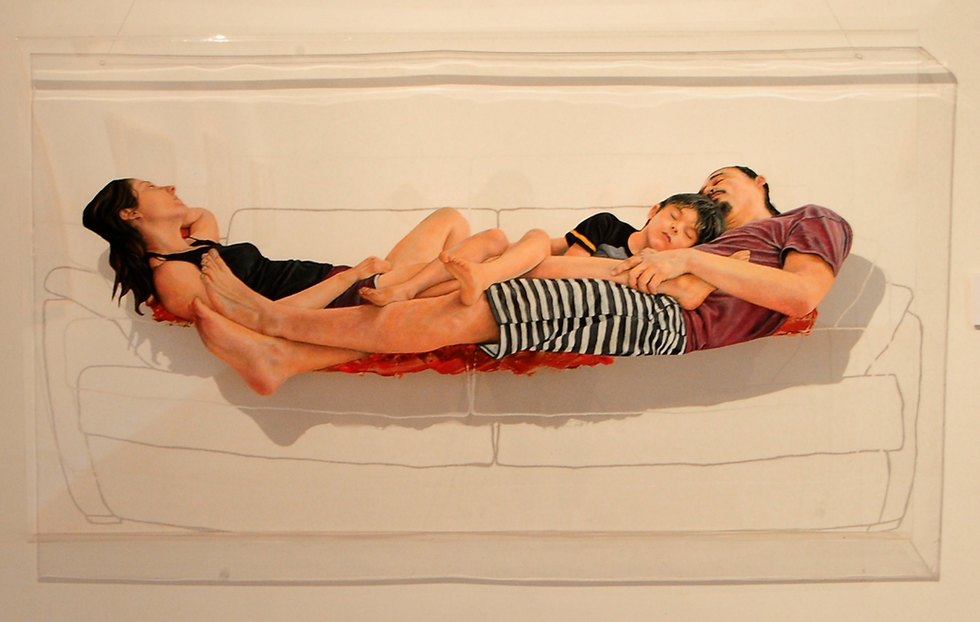
One of the most significant aspects of her research lies in the use of methacrylate as a pictorial support. Since 2012, this material has functioned not merely as a surface, but as an active agent in the construction of meaning. The transparency and reflective capacity of acrylic introduce an unstable dimension into the image: what is seen is never fixed, but rather a superimposition of visual layers in which viewer, environment, and artwork mutually contaminate one another. In this sense, painting ceases to be a window and becomes a threshold.
This material decision is not merely technical, but profoundly conceptual. Methacrylate allows the image to breathe, enabling space to infiltrate it and the viewer’s body to participate in its activation. The work is therefore not completed on the surface, but through the act of perception itself. Aesthetic experience becomes a situated event in which “seeing” also implies being seen, reflected, and displaced.
From a curatorial perspective, López Anaya’s production may be understood as an ongoing investigation into the limits of presence. Her inquiry into the possible “absence of the body” does not point toward literal disappearance, but toward its transformation into trace, into a sensitive residue. In a contemporary context marked by image saturation and the virtualization of experience, her work recovers the tactile and phenomenological dimensions of perception without relinquishing conceptual complexity.

Throughout a trajectory that includes solo exhibitions such as Transparency in Painting (2024) and Nomadic Thought(2016), as well as extensive participation in international group exhibitions, her work has consolidated a discursive coherence that articulates body, memory, and space through an expanded understanding of painting. Yet this coherence does not imply repetition, but rather an insistence on variation: each work reconfigures the conditions of visibility and proposes new forms of relation between matter and intention.
On a broader level, her practice may be situated within contemporary discussions surrounding the dematerialization of the image, the crisis of representation, and the reconfiguration of the subject in the era of visual hyperconnectivity. However, far from adopting a purely critical or technological stance, López Anaya introduces a sensitive dimension that restores density to the act of looking. Her works do not illustrate theories: they embody them.

Perhaps the most significant aspect of her proposal lies in the way she displaces painting toward a relational field. The work is no longer an autonomous object, but a perceptual situation. In this sense, the viewer does not confront an image, but becomes implicated within it. This implication is not symbolic, but physical and spatial: the observer’s body becomes part of the visual dispositif.
In conclusion, Anna López Anaya’s work offers a significant contribution to contemporary pictorial practices by redefining the relationship between body, materiality, and perception. Her research does not seek closed answers, but rather opens zones of indeterminacy in which space ceases to function as a container and instead becomes experience itself. Within this transition, painting expands, the body dissolves, and the gaze becomes an act of shared presence.


Comments