
Oskar Romo: La mancha como lenguaje del conflicto
Research and writing: Area Temporal Editorial TeamArchive: Artistic Mapping Open Call 2026
Oskar Romo’s work is grounded in a persistent investigation: how painting can still operate today as a dispositif of thought capable of articulating contemporary experience without renouncing its material condition. Over more than three decades, his practice has consolidated a language in which the stain ceases to be merely a formal resource and instead becomes a conceptual structure through which meaning is constructed.
Within this framework, his work is organized around a constant concern with the human condition in states of tension, where violence and sexuality function as primal impulses traversing both the individual and the collective. These forces are not addressed literally, but embodied through painting itself: through gesture, the friction of the mark, and the insistence of matter. Consequently, the image does not represent conflict — it produces it.

In works such as Hell, this logic becomes evident. Painting is configured as a field of intensities where forms do not stabilize, but emerge and dissolve within the same movement. The stain, charged with energy, exceeds every attempt at containment and transforms the surface into a site of confrontation. There is no composition in the classical sense, but rather an organization of forces in which the body — fragmented, displaced, unstable — appears as a territory traversed by multiple tensions.
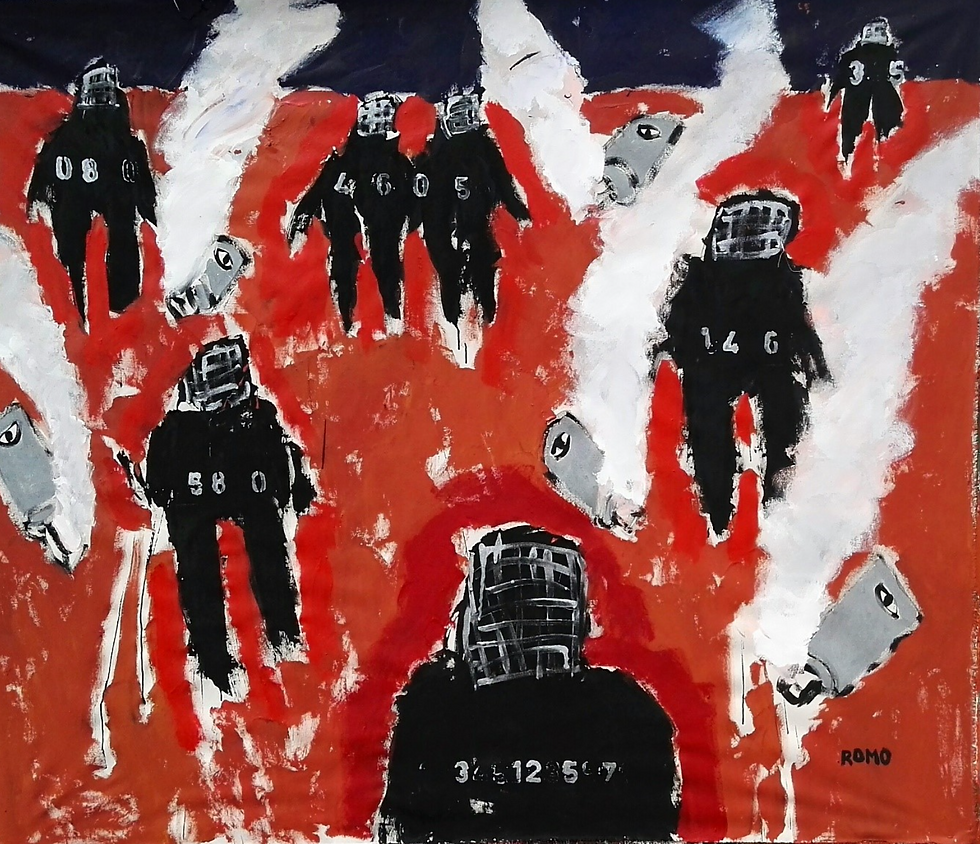
This dimension finds a counterpoint in other lines of his production where the figure, although more legible, remains equally vulnerable. There, drawing introduces an economy of means that does not reduce complexity, but shifts it toward the symbolic: schematic bodies, signs, and narrative fragments configuring states of being rather than fixed identities. In both cases, the operation remains the same: to construct a “visual alphabet” in which each element participates within a larger system that does not seek to explain, but to activate readings.
The relevance of Romo’s work lies in this structural coherence. His practice does not fragment into autonomous series, but articulates itself as a continuous field of investigation in which each work expands upon the same question: how to sustain painting as a language capable of thinking the political, the corporeal, and the historical simultaneously. In this sense, his approach may be situated within a post-conceptual logic where materiality does not disappear, but becomes subordinated to reflective intention.

Thus, the stain becomes the site where his interests converge: not as accident, but as evidence of a process in which thought itself becomes matter. It is there that painting acquires its critical potency, transforming into a space where the experience of conflict is not narrated, but made visible, tensioned, and ultimately experienced.


Comments