
Pedro Milagres: Living Machines and Sculptures for a Landscape in Transformation
Research and writing: Area Temporal Editorial TeamArchive: Artistic Mapping Open Call 2026
Pedro Milagres’s work transforms sculpture from a static object into a hybrid organism — a system of tensions where living matter, electronic devices, and the residues of technical culture remain in constant dialogue. His production occupies a territory close to the tradition of the modern ready-made, not only through the incorporation of found objects and preexisting mechanisms, but through the conceptual operation that redefines the function of what we observe. In Milagres’ work, the machine no longer responds solely to industrial logic; it acquires an organic, vulnerable, and even ecological dimension.
Born in northern Minas Gerais, a region deeply marked by the relationship between territory, extraction, and landscape, the artist develops a practice profoundly traversed by the idea of coexistence. His sculptures and installations resemble post-industrial assemblages: precarious structures, experimental artifacts, and sculptural devices evoking improvised laboratories, archaeological remains from the future, or technologies in a state of decomposition. Yet far from any futuristic fascination, these works reveal an interest in that which resists human domestication. Mycelium — a central element in his research — emerges both as metaphor and material: a subterranean intelligence that silently connects, transforms, and reorganizes its environment.


In this sense, Milagres displaces the tradition of the found object toward a contemporary sensibility shaped by environmental crisis. If those historical operations questioned the status of the artistic object within industrial society, Milagres’ works seem to ask what happens to those objects once nature begins reclaiming them. Wires, metallic structures, sensors, and industrial materials coexist with living organisms and processes of deterioration, configuring sculptures that do not present themselves as finished forms, but as bodies in permanent transformation.
There is also an important fictional dimension within his practice. His installations function as speculative scenes where nature and technology cease to operate as irreconcilable opposites. The artist imagines sensitive machines, artifacts capable of listening to the environment, structures in which the electronic and the biological mutually contaminate one another. This quality gives his work an ambiguous atmosphere: suspended between scientific experiment and poetic ruin, between engineering and ecosystem.
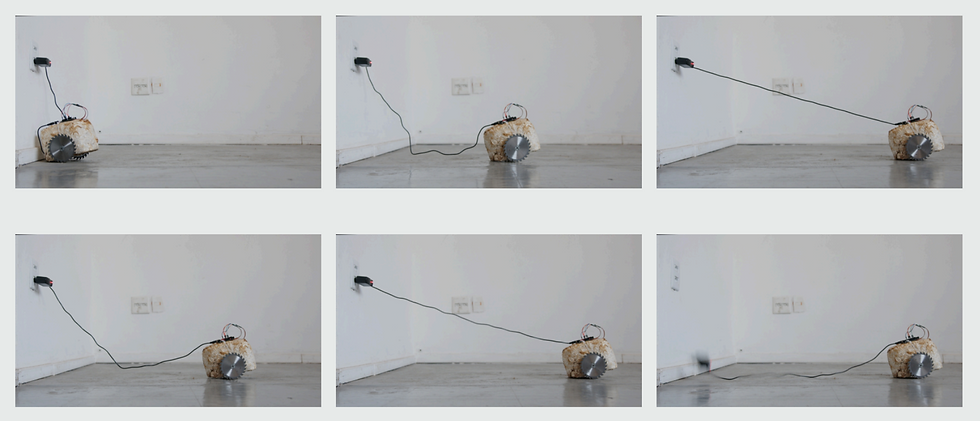
The relevance of Pedro Milagres’ practice lies precisely in this capacity to reconfigure contemporary sculpture as a space of negotiation between bodies, territories, and living systems. His works neither celebrate technological supremacy nor idealize nature; rather, they reveal the constant conflict between control and coexistence. Each object seems to ask to what extent we are still capable of inhabiting the world without reducing it to resource, interface, or domesticated landscape.

Through a production that traverses sculpture, installation, and video art, Milagres constructs a poetics of interdependence. His sculptural machines, shaped by a radically ecological sensibility and by the resignification of everyday objects, propose new ways of imagining the relationship between humanity and environment: not through domination, but through mutual contamination, fragility, and continuous transformation.


Comments